The first time I looked down at Navagio from the cliff edge, I was five years old. I still remember how powerful that first impression was. More than fifteen years later, the view continues to take my breath away every time I visit. Some places simply never lose their magic
The Postcard That Became a Legend
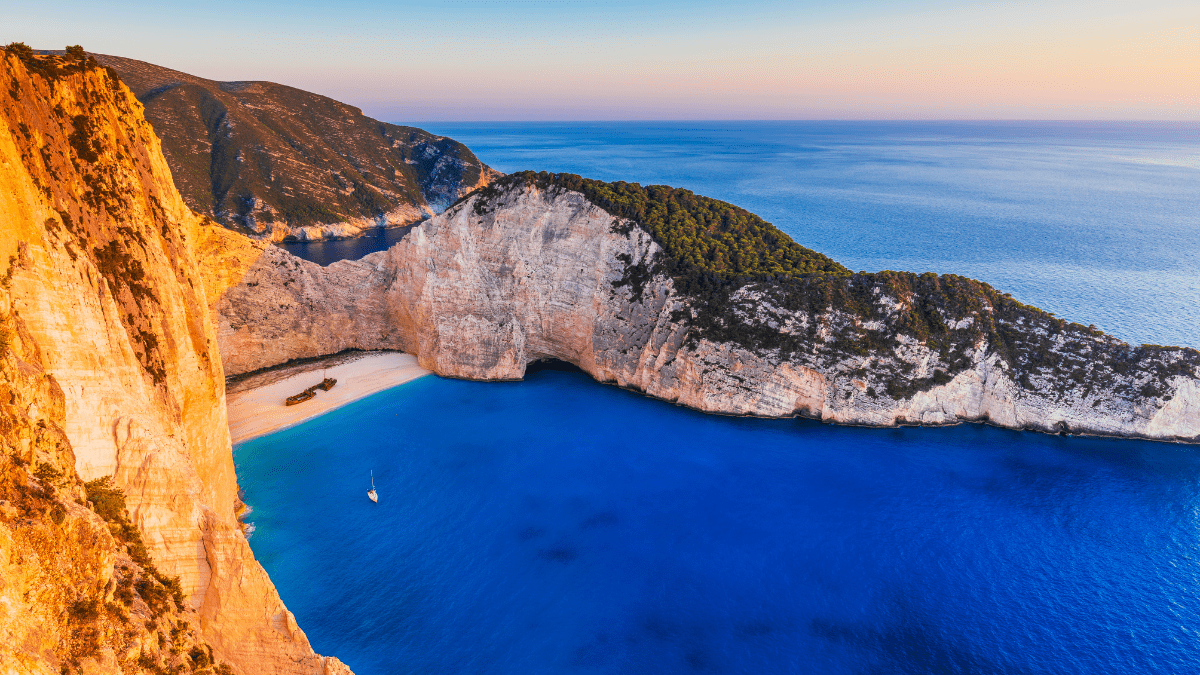
Type ‘Zakynthos’ into any search engine on the planet and within three seconds you are staring at it: a perfect arc of dazzling white pebbles, water so impossibly turquoise it looks digitally enhanced, sheer white limestone cliffs rising hundreds of metres on three sides, and in the centre of the beach — rust-red, sun-bleached, slowly dissolving — the wreck of the MV Panagiotis. This is Navagio Beach. Shipwreck Bay. The single most photographed beach in the Mediterranean and arguably one of the most recognisable natural landmarks in the world.
I have been here more times than I can count. I have been here at dawn, at dusk, in the full glare of August midday, in the off-season when the bay is empty and the gulls wheel overhead and the wreck drips rust into the white pebbles. And I can tell you with complete honesty: it is more beautiful in real life than in any photograph you have ever seen. That is a rare thing. That is a Zakynthos thing.
The True Story of the Shipwreck
Most visitors assume the famous shipwreck at Navagio has always been there. In fact, it arrived relatively recently. The vessel we now know as the MV Panagiotis ran aground on this beach in October 1980.
What many people don’t realise is that the ship already had a long history before ending up on Zakynthos. She was built in Scotland in 1937, originally sailing under the name St. Bedan. During the Second World War, the vessel even took part in the Dunkirk evacuation in 1940, helping transport soldiers during one of the most dramatic rescue missions of the war.
Decades later, the ship became part of a very different story. According to local accounts, the vessel was allegedly involved in smuggling cigarettes and alcohol when it was caught in a storm while trying to evade the Greek coastguard. The crew escaped or were rescued, the ship was abandoned, and the beach received the name it carries today: Navagio, which simply means shipwreck in Greek.
Since then, wind, salt and time have slowly shaped the wreck. Locals remember when the hull was still largely intact. Today the bow has partially collapsed, the metal has deepened into rich rust tones, and seabirds nest in the hollow spaces inside. Over the years the island has gradually reclaimed the vessel, turning it into one of the most photographed and unforgettable places in Greece.
The Reality of Visiting in Peak Season (And Why It Matters)
I need to be honest with you about something, because I believe you deserve the truth more than a comfortable fantasy: Navagio in July and August, if you go the wrong way, can be genuinely disappointing. During peak season, the bay fills up with large boats carrying 100, sometimes 350 people. The natural wonder is still there, the cliffs, the water, the wreck, but the magic of being in the presence of something extraordinary is diluted by the crowds.
This is precisely why at Nefis Travel we have always approached Navagio differently. We use small speedboats with a maximum of 25 guests. Our guides know exactly when and how to arrive to avoid the flotilla of large vessels. And our tour is timed around it on our group tour shipwreck bay and the blue caves tour we are there as on of the first ones of the day while with our above and beyond semi-private tour we are there after the morning rush.
The Nefis Travel VIP Approach to Navagio
▸ The Speedboat Advantage
Our VIP Shipwreck and Blue Caves Excursion uses fast, comfortable speedboats that can reach Navagio more quickly than the big boats, go closer to the beach for pictures, and depart earlier in the morning or later in the afternoon to catch the beach at its least crowded. The difference in experience between arriving at Navagio on a quiet morning on a small speedboat with 19- 25 people, versus arriving on a large boat with 100 strangers, is simply incomparable.
Swimming on the West Coast
While Navagio (Shipwreck Beach) is one of the most iconic sights of Zakynthos, swimming directly at the beach is currently not possible. Instead, we take you to some of the most beautiful and peaceful swimming spots along the west coast.
One of our favourite stops is the small island of Agios Andreas, where the water is incredibly clear and perfect for a refreshing swim. Surrounded by the deep blues of the Ionian Sea and the dramatic cliffs of the west coast, it is a wonderful place to relax and enjoy the sea.
On our Above & Beyond experience, we continue even further along the spectacular coastline. Here you’ll discover hidden gems such as White Beach, the wild beauty of Sfogio Beach, and the magical Maravelia Cave, where the colours of the water and rock formations create an unforgettable setting.
These quiet spots capture the true feeling of the west coast — crystal-clear water, impressive cliffs, and the sense that you have discovered a part of Zakynthos that many visitors never see.
▸ The Cliff-Top Viewpoint
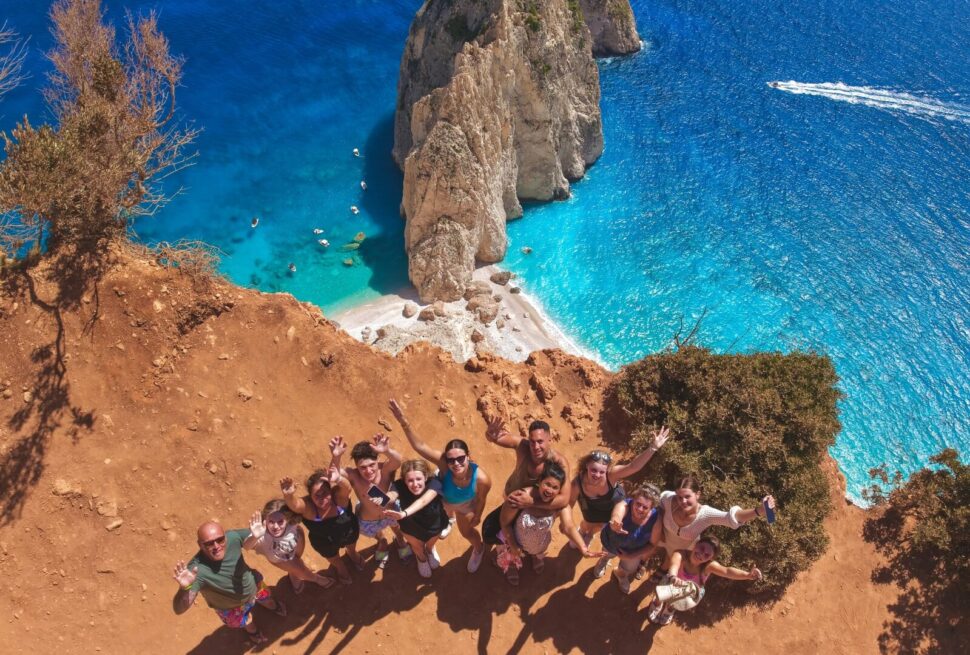
Our ‘VIP Above and Beyond Shipwreck Tour’ adds what I consider to be the definitive Navagio experience: the cliff-top viewpoint. This requires a minibus journey to the top of the cliffs, where a viewing platform juts out over the void 300 metres above the beach. The view from up here — looking straight down at the beach, the wreck, the water — is the image you know from every Zakynthos postcard and magazine feature. Being there in person, with the wind in your hair and the Ionian stretching to the horizon in every direction, is one of those experiences that makes you understand why people travel.
Nefeli's Timing Secret: Visit Navagio before 10 am or after 1 pm for the fewest crowds and the most dramatic light. Our tours are scheduled accordingly — this is not an accident.
The Blue Caves: The Perfect Partner
Our Navagio excursions also include a visit to the famous Blue Caves at Cape Skinari — and this is often the moment that surprises guests the most. If Navagio is Zakynthos’ most iconic sight, the Blue Caves are its most magical natural phenomenon.
These sea caves, carved into the island’s northern limestone cliffs, create an extraordinary optical effect. Sunlight passes through the crystal-clear water and reflects off the pale seabed, filling the caves with an intense, glowing blue light that seems to come from the sea itself.
With our perfectly sized speedboats, we are able to enter several of the caves and bring you right into this incredible blue world. And if you jump in for a swim, you’ll quickly discover why locals love this spot — the reflection of the water makes your skin glow bright blue… sometimes guests joke they come out looking like a Smurf!
Photos never quite capture it, and descriptions never fully prepare you. It’s one of those places you simply have to experience for yourself — floating in the glowing water, surrounded by rock and light, in one of the most unique natural settings in Greece.
Practical Information
Best time to visit: May–June and September–October for fewer crowds. Early morning or late afternoon before or after the morning rush
Accessibility: Navagio- shipwreck bay is only reachable by boat — there is no land access to the beach itself.
What to bring: Swimwear, water shoes (the pebbles can be sharp at xingia sea spa ), sunscreen, a waterproof case for your phone, and a sense of wonder.
Photography tip: Shoot from the cliff-top viewpoint for the iconic overhead image. At beach level, shoot in the afternoon light for the warmest colours on the wreck.
Book Your VIP Shipwreck & Blue Caves Excursion nefis-travel.com | Small groups | Expert guides | Free resort transfers Book Now, Pay Later — WhatsApp: +30 6987746506